
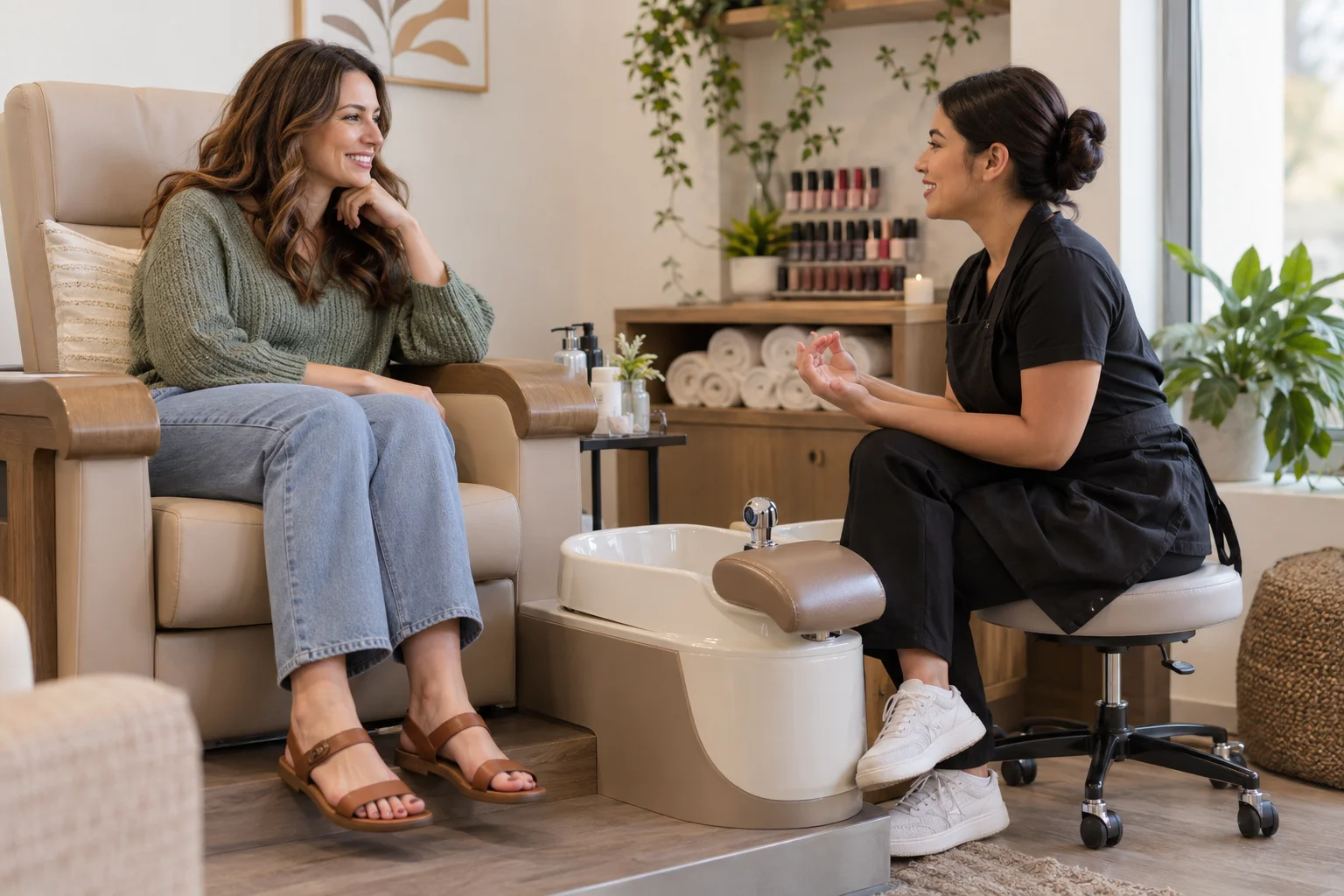
Before your first pedicure appointment, confirm what the service includes and ask about basin and tool cleaning before treatment starts. For a foot soak, the EPA advises avoiding leg hair removal for the preceding 24 hours and keeping broken skin out of foot-spa water—including cuts, scratches, and scabbed wounds.
You do not need to know every salon term. This step-by-step guide translates EPA and professional foot-care guidance into questions you can ask, preferences you can explain, and reasons to postpone or seek individualized advice. These precautions do not guarantee an infection-free service.
1. Confirm what you are booking
Start with the result you want: neatly shaped toenails with regular polish, for example, or a tidy-up without color. Then ask what the salon’s service includes rather than relying on the package name.
- Service steps: “Does this include a soak, nail shaping, cuticle work, callus smoothing, and polish? Can I skip a step?”
- Existing product: “I have polish on my toenails. Is removal included, and do you need to know what type it is?”
- Time and cost: “How long should I allow, and what is the total quote for the service and removal I’ve described?”
- After polishing: “What should I know about drying time and footwear for the polish option I choose?”
If you do not know what product is on your nails, say so rather than guessing. The guide to booking removal at a different salon offers questions to help explain an unfamiliar product.
Raise any firm preferences now. If you want no cuticle cutting or no callus work, confirm that the salon can accommodate your request before booking.
2. Check whether to proceed before preparing your skin
If you have diabetes or poor circulation, the American Podiatric Medical Association (APMA) recommends consulting a podiatrist before a pedicure. APMA also directs people prone to ingrown toenails toward podiatric advice. That calls for an individualized plan, not a blanket prohibition on every pedicure.
During the 24 hours before foot-spa treatment, avoid shaving, waxing, and hair-removal creams on your legs, as recommended in EPA’s foot-spa guidance. There is no need for a last-minute attempt to make your legs “salon ready.”
The 24-hour interval does not override skin condition. EPA also says to keep broken skin—including cuts, scratches, and scabbed wounds—out of foot-spa water. Check your feet and lower legs before leaving home.
If you find broken skin, contact the salon to postpone the planned foot-spa treatment rather than expecting to proceed as booked. Skipping the soak is not, by itself, medical clearance for the remaining service. If you are unsure what is appropriate for your feet, seek individualized clinical advice.
3. Ask about basin disinfection before the soak
Before putting your feet in, ask: “How do you clean and disinfect this basin between customers?” Follow up with: “What disinfectant do you use, and how long does its label say it needs to stay in contact?”
EPA guidance calls for foot-spa disinfection between customers and nightly, using an EPA-registered hospital disinfectant for its full labeled contact time. The relevant timing comes from that product’s instructions—not a universal number of minutes. For a spa that circulates water, also ask how its filters and circulating components are maintained.
Use the answer to understand the process, not to certify the salon. A basin’s appearance alone cannot tell you whether the required disinfection steps were completed.
If the explanation is vague, make the follow-up specific: “Was this basin cleaned and disinfected after the previous customer, including the required contact time?” EPA advises not using a foot spa if you are unsure it has been disinfected. You can decline the soak or end the appointment without having to prove that the salon is unsafe.

4. Ask a separate question about tools and files
Basin cleaning does not answer how instruments are prepared. Ask: “How are reusable tools processed between clients, and which files are new for my appointment?”
APMA’s pedicure pointers recommend personal pedicure utensils and say emery boards should not be shared unless replaced between customers. If you want to bring your own kit, ask the salon beforehand whether it accepts personal tools and how they should be prepared.
A personal kit does not eliminate the cleaning question or address the basin and other parts of the service. It is not a guarantee against infection.
If the response is simply “everything is sanitized,” ask what happens to reusable tools after one customer finishes and before the next service begins. Cleaning, disinfection, and sterilization should not be treated as interchangeable descriptions. This consumer guide does not prescribe a universal tool-processing method.
5. Agree on cuticles, calluses, and nail length
State your preferences before the technician starts. You could say:
“This is my first pedicure. Please leave my cuticles uncut, don’t use a callus razor, and check with me before shortening my nails. Please explain each step before starting it.”
The requests to avoid cuticle cutting and foot razors follow APMA’s advice, which also recommends gentle callus smoothing. You can decline callus work altogether; if you choose smoothing, ask for a gentle approach rather than removal of every patch of thickened skin.
The professional sources differ on cuticles. FootCareMD permits careful trimming of clearly overhanging cuticle tissue, while APMA advises against cutting cuticles. Leaving them uncut is a conservative preference you can communicate clearly.
FootCareMD also recommends trimming toenails straight across rather than rounding the corners and cautions against cutting too short. Ask the technician to confirm the proposed length before trimming. For recurring ingrown toenails, follow APMA’s recommendation to seek podiatric advice rather than asking a cosmetic service to resolve the problem.
6. Speak up during the service
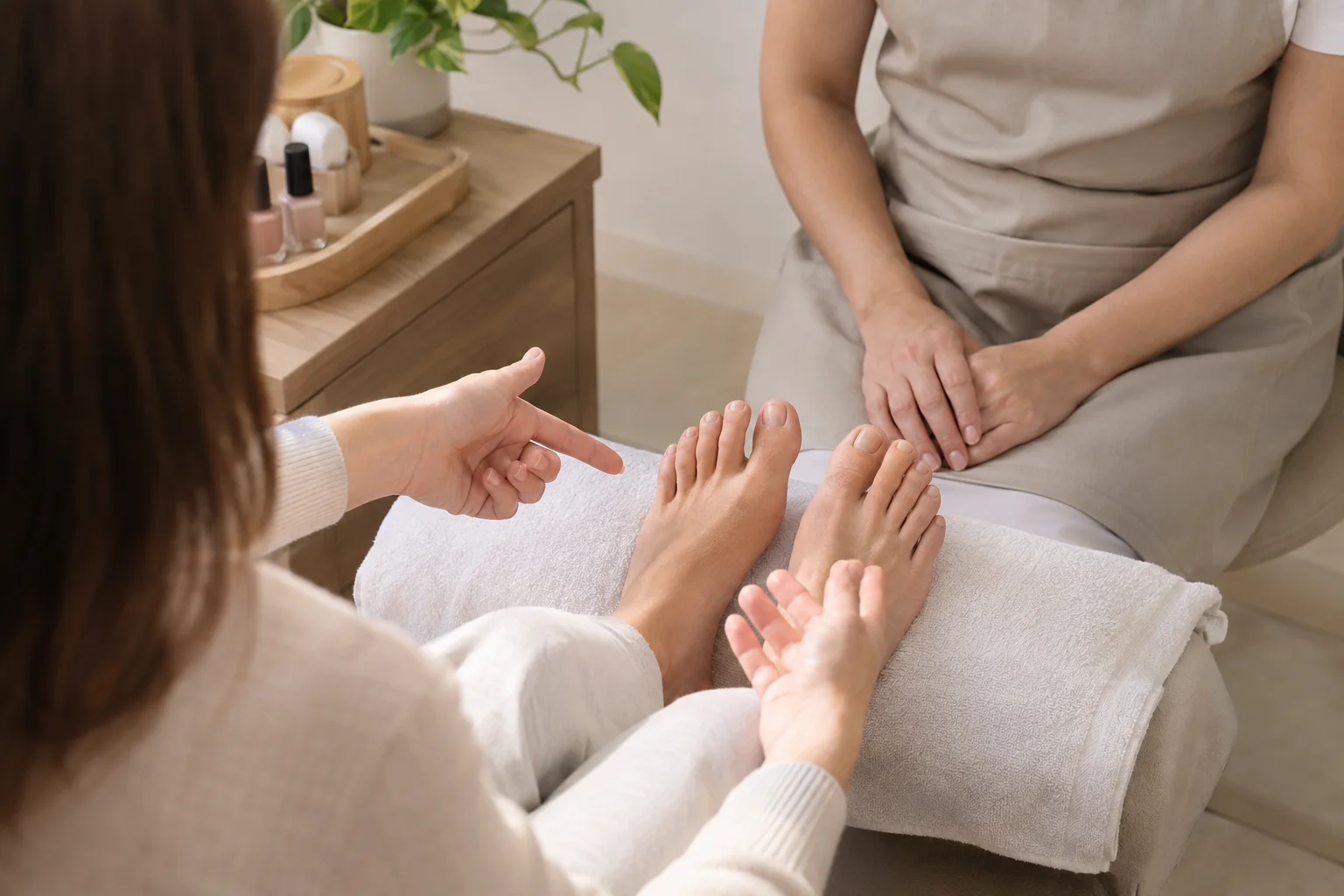
Your initial agreement does not mean you must continue every step. If something hurts, feels uncomfortable, or differs from what you discussed, say: “Please pause. I’m uncomfortable with that step, and I don’t want to continue it.”
You do not need to identify a technical mistake before asking someone to stop. Ask what the step involves, decide whether you want it, and confirm any change to the service or quote before proceeding.
Your appointment checklist
- Confirm the included steps, existing-polish removal, appointment length, and total quote.
- Follow the pre-soak hair-removal precaution and check for broken skin.
- Seek podiatric advice first when diabetes, poor circulation, or recurring ingrown toenails apply.
- Ask about basin disinfection, reusable tools, and fresh files before treatment.
- Explain your preferences for cuticles, calluses, and nail length.
For other appointment decisions, explore Salon Visits & Service Guides. Confirm provider-specific details directly with the salon; a directory listing alone does not establish its hygiene practices or suitability for you.
The most useful preparation is a clear conversation before the soak or tools touch your feet. Know what you have booked, ask specific hygiene questions, and agree on what you do—and do not—want done. If the answers leave you uncertain, you can pause or decline the service.