
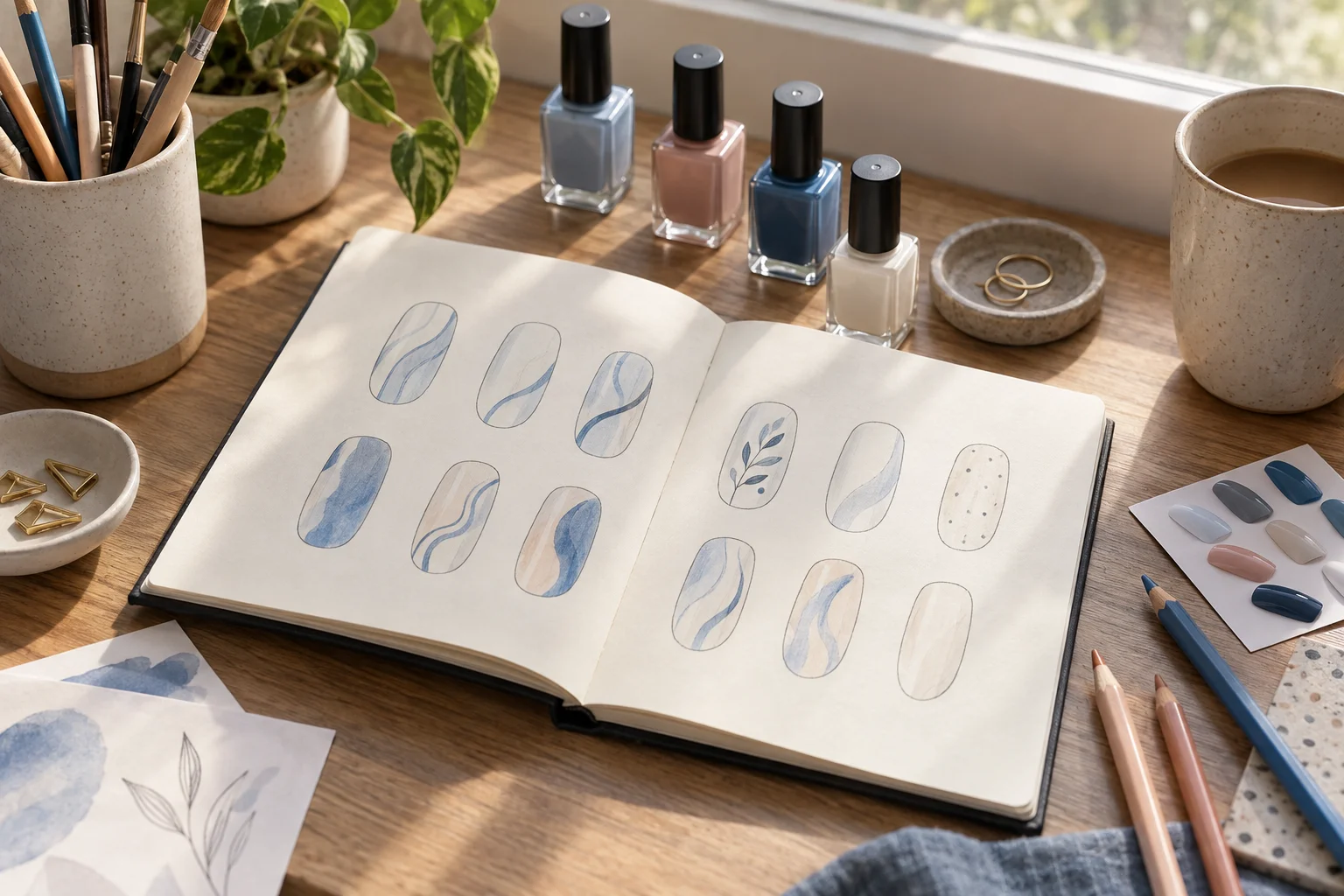
Julie Kandalec’s nail art sketchbook offers a useful idea for customers: think through the design before the polish. According to NAILS’ June 1, 2020 launch report, her Nail Art Design Book grew out of an assignment that required planning 40 nail looks. You do not need a special book to apply the principle—start by identifying the colors, shapes, and details you want to discuss with your nail artist.
This historical spotlight draws on a published interview, launch coverage, and Kandalec’s official biography. It is not a new interview or a hands-on assessment of the book.
An early interest in small-scale art
In her interview with The Newsette, Kandalec recalled childhood interests in miniatures, painting, and crafts. She described a beauty-school field trip that connected those interests with nail art: a medium that brought her creative interests together.
Her official biography identifies her as Paintbox’s founding creative director and describes editorial and campaign work. That professional background provides context for the sketchbook’s origin—a design assignment with many individual looks to resolve.
For a customer, there is a smaller planning question worth considering: what do you want to happen within the space of each nail? Choosing blue, for example, still leaves room to discuss a solid wash of color, a narrow line, or a single blue accent across the set.
The 40-look assignment behind the book
According to NAILS’ 2020 account, Kandalec sketched 40 nail looks for an assignment during a flight home from Tokyo. The publication reported that her self-published Nail Art Design Book was released on June 1, 2020. The launch is historical context, not a current product announcement.
The revealing detail is the scale of the task: many separate ideas to consider before execution. Sketching was part of that reported process, but the account does not establish how much time it would save in an ordinary salon appointment.
A customer’s version of the exercise can be much simpler. Would you like one motif repeated across both hands, a pattern that changes from finger to finger, or mostly plain nails with a detailed accent? You can bring those choices to a consultation without producing a finished drawing.
A sketchbook with an educational purpose
The launch coverage described the original edition as a 42-page sketchbook incorporating color theory and color-combination ideas. The brand’s official description calls the book a full-color, spiral-bound educational sketchbook with metallic ink.
Those descriptions explain its intended role: a place to develop designs alongside educational material. They are not independent evidence that the book improves manicure results or makes appointments faster. The original edition’s specifications also should not be read as current buying information.
The useful distinction for readers is between a planning tool and a promised outcome. This story offers a reason to explore ideas on paper—not a reason to believe you must buy a particular sketchbook before asking for nail art.
Bring the planning idea to your consultation
The following are Nail Masters USA’s editorial suggestions, not quotations from Kandalec or a method reproduced from her book. Use them to explain your priorities while leaving room for your artist’s recommendations.
- Color: “Which colors are essential to this idea, and which could change?” Decide whether you love the exact shades or the contrast between them.
- Shape and length: “How would you adapt this design to the length and shape I want?” Make your preferred length part of the discussion rather than assuming the reference must be copied exactly.
- Placement: “Could we try this detail on just the middle and ring fingers?” Naming the positions you have in mind gives the artist something specific to respond to.
- Finish: “Is the effect I like mainly the color, the shine, or the texture?” For ideas about shine placement, see our guide to combining matte and glossy finishes.
- Scope: “What version can you offer within my appointment time and budget?” Ask for confirmation of the design, service, and quote before committing.
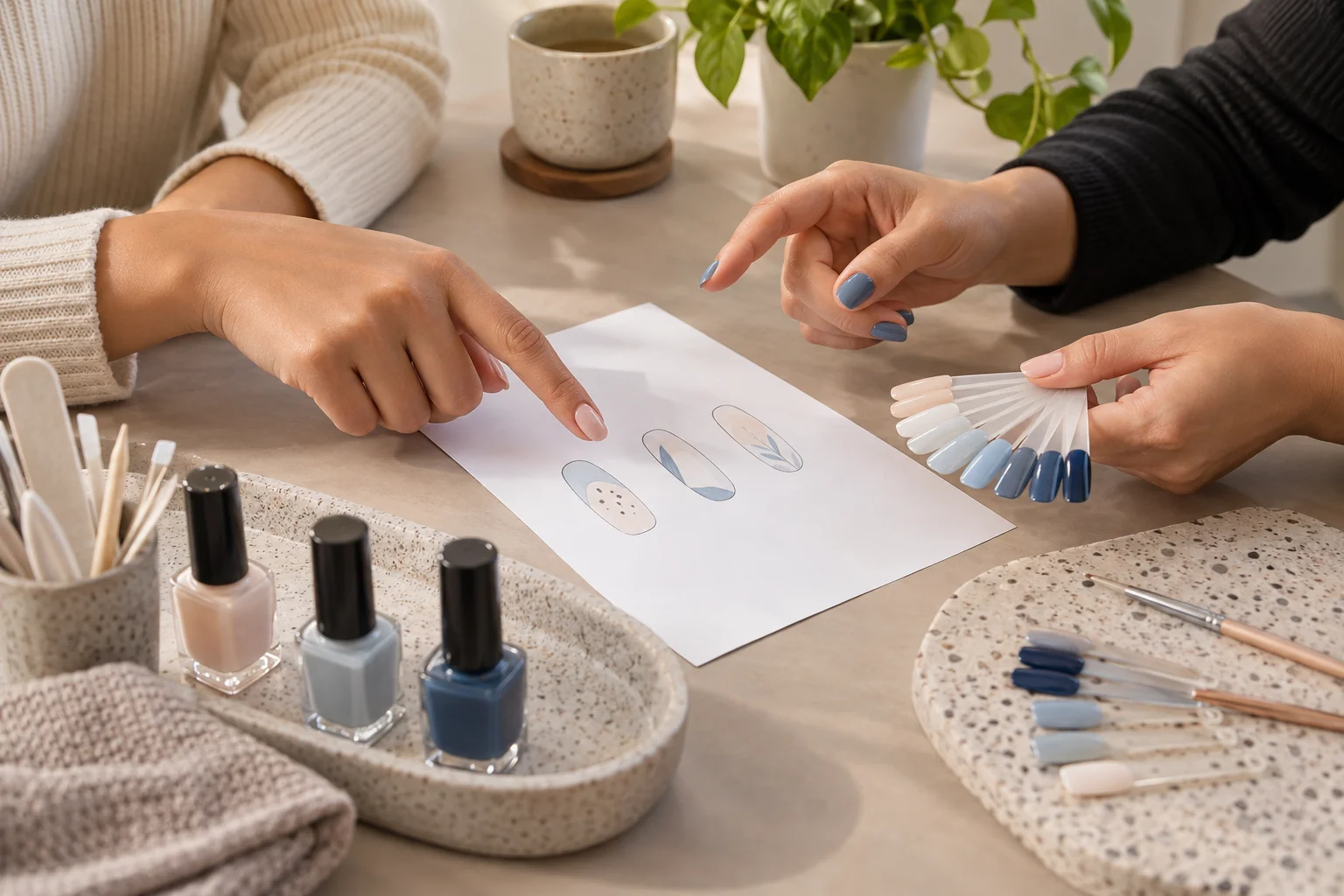
Before booking, ask whether the provider would prefer reference images or a rough sketch sent ahead. Confirm that the artist offers the kind of work you want; a directory category does not establish that every listed salon provides a particular design or technique.
Make a simple paper brief
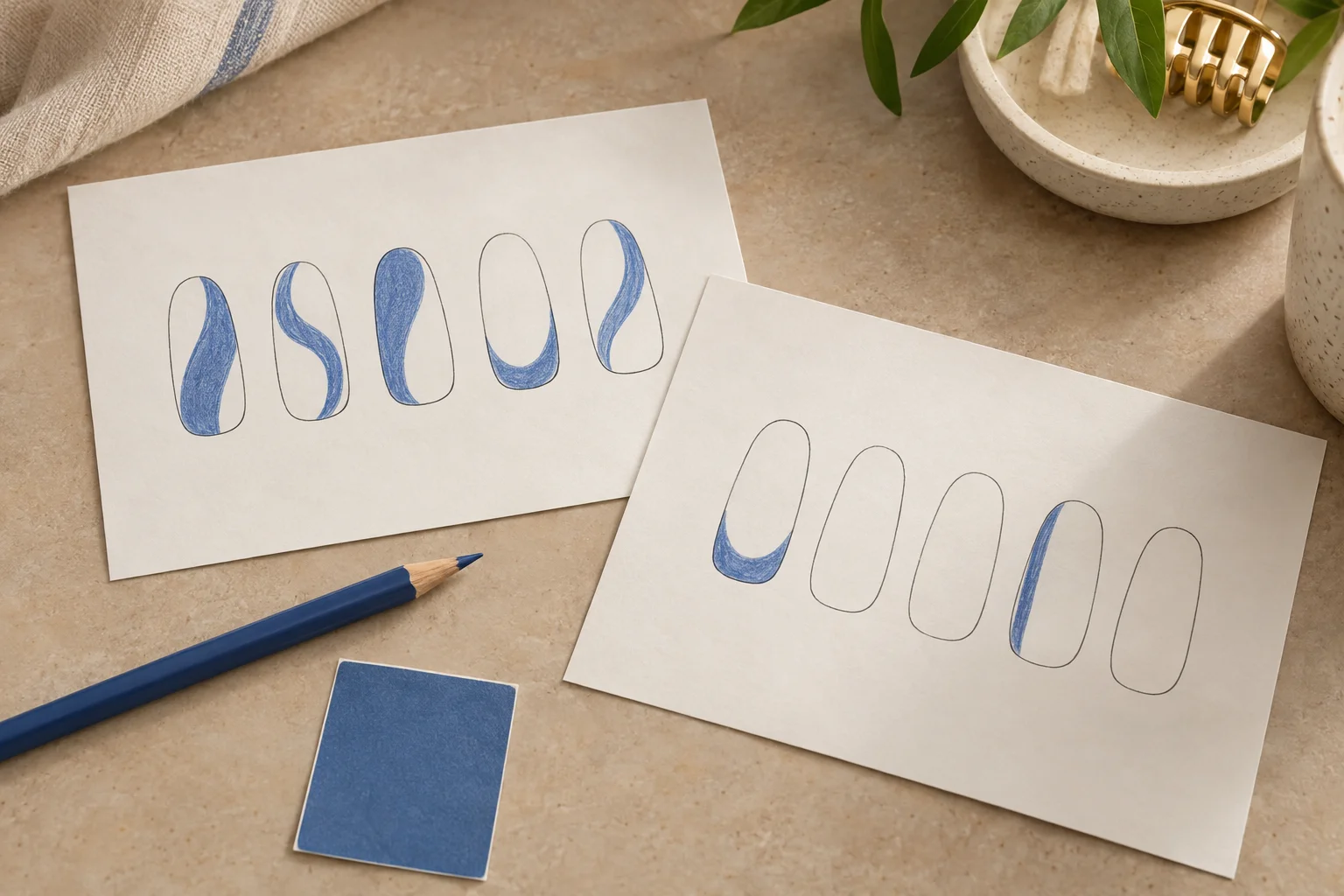
For an optional planning exercise, draw five rough nail outlines for each hand. Mark the main color and add only the details whose positions matter to you. Lines, dots, and written notes are enough—the aim is to communicate, not demonstrate drawing skill.
Hypothetical example: You want a pale base with blue curved lines, but not a different pattern on every finger. Your sketch could leave the thumbs, index fingers, and little fingers plain, with a blue curve on each middle and ring finger. Add a note: “The blue is important; the exact curve is flexible. Please adapt it to my preferred short length.”
Separate your preferences into keep and open to change. In this example, blue and short length belong under “keep”; the curve’s shape and position could remain open for discussion. If the full idea is outside the available time or budget, ask which detail could be simplified while preserving what you like most.
Treat the sketch as a conversation starter, not a technical instruction sheet or a guarantee of the finished result. You can also explain the same priorities with a reference image and a few notes.
Kandalec’s sketchbook story draws attention to the decisions that come before painting. For your own manicure, bring clear priorities rather than an inflexible blueprint: identify the colors you love, show where you imagine the detail, and ask what your artist would adapt. A useful design conversation does not require a beautiful drawing.